
You had a baby. Your back hurts. Everyone tells you it's normal — the posture changes, the lifting, the feeding positions, the sleep deprivation catching up with your body.
And some of it is. But if your back pain has stuck around longer than it should, or keeps coming back no matter what you do, there's something else worth knowing about. Something most postpartum care — and most chiropractic care — completely misses.
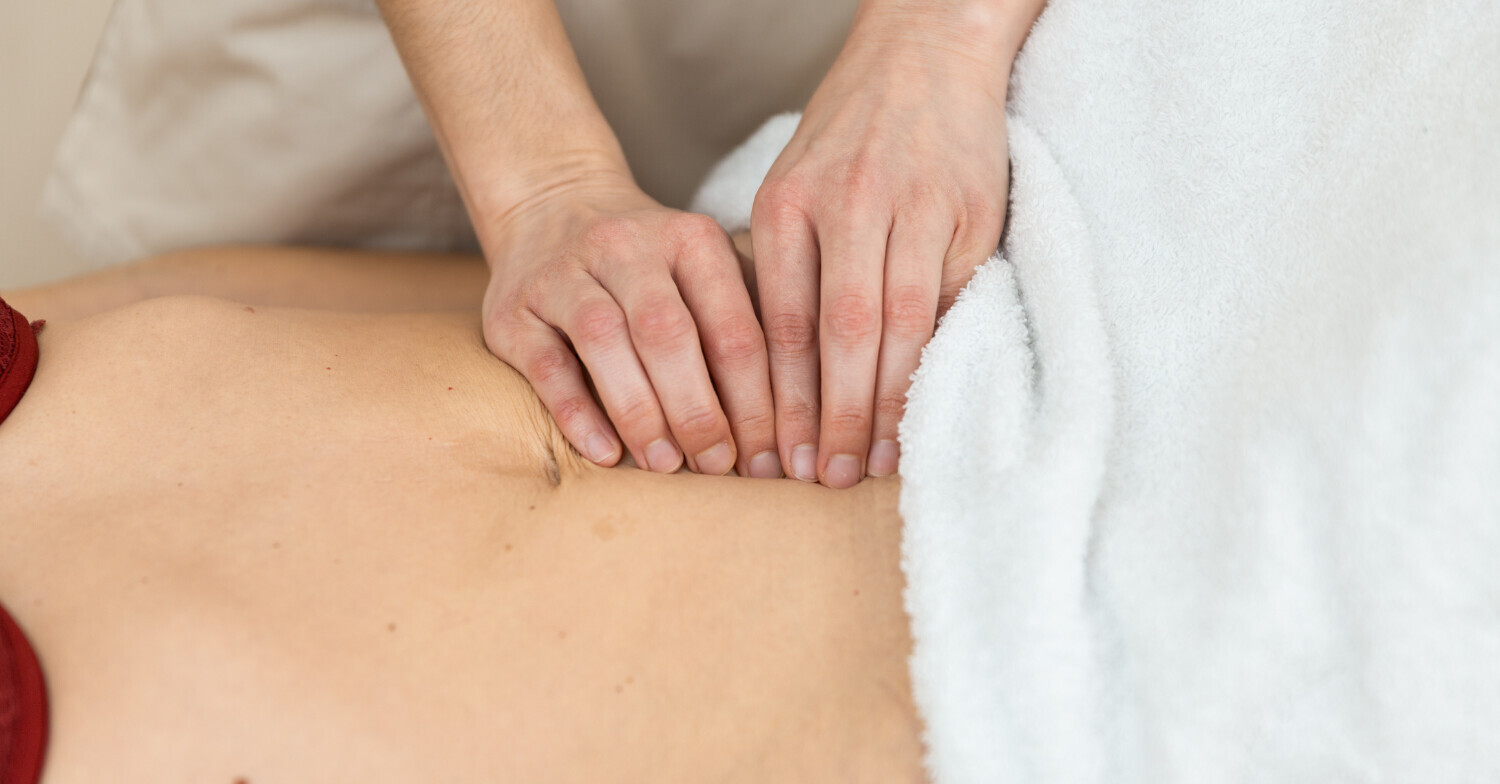
Your core might be the problem. Specifically, a condition called diastasis recti that affects most women who've been pregnant — and that quietly undermines your back, your posture, and your ability to recover long after the baby is here.
What Is Diastasis Recti?
During pregnancy, your growing baby puts significant pressure on your abdominal wall. The two vertical columns of muscle that run down your abdomen — the rectus abdominis — are connected at the midline by a band of connective tissue called the linea alba. As your belly expands, this connective tissue stretches and thins, causing the two muscle columns to separate.
This separation is called diastasis recti. And here's the important thing: it doesn't automatically resolve after you deliver. For a significant number of postpartum women, the separation persists for months or years — and becomes the hidden driver of ongoing back pain, poor posture, and a core that never quite feels like it came back online.
The Myth: Your Back Pain Is a Back Problem
Here's what most people — including most providers — miss about postpartum back pain: the spine is often not the primary source of the problem. The primary source is a core that has lost its structural integrity.
Your abdominal muscles are part of a pressure system that supports your spine. When that system is intact, your spine has a stable foundation. When the abdominal wall is separated and the linea alba is weakened, the system fails — and your back muscles are left doing work they were never designed to do alone.
The result is chronic low back pain, sacroiliac joint dysfunction, poor posture, and that familiar new-parent forward slump that never quite resolves even when you consciously try to stand up straight. Adjusting the spine can help — and it does — but if the core isn't addressed, the support structure that should be holding everything together isn't there. Relief is temporary.
This is why some postpartum patients respond beautifully to chiropractic care and others plateau. The ones who plateau often have a diastasis that hasn't been identified or treated.
Signs Your Postpartum Back Pain May Be DR-Related
- Your back pain has persisted well beyond your six-week postpartum checkup
- Your core feels "disconnected" or like you can't find it when you try to engage it
- You notice a visible ridge, dome, or cone shape down the center of your abdomen when doing any abdominal effort — getting up from bed, sitting up, lifting
- Your belly still looks pregnant or pouchy despite returning to your pre-pregnancy weight
- You have urinary leakage, pelvic pressure, or a sense of pelvic floor weakness
- You feel unstable or unsupported through your midsection during movement
Any of these is worth paying attention to. A simple self-check can give you a starting answer — Diastasis Rehab has a free guide to checking your belly for separation at diastasisrehab.com/pages/check-belly.
What Actually Helps
Diastasis recti is not fixed by crunches. In fact, traditional abdominal exercises that dome or crunch the midline — sit-ups, crunches, many Pilates moves, intense yoga postures — can actively make it worse by putting more force through the already weakened connective tissue.
The evidence-based approach to closing a diastasis is the Tupler Technique® — a four-step program developed by Julie Tupler, RN, that focuses on strengthening the connective tissue and repositioning the abdominal muscles through specific exercises, splinting, and movement pattern retraining. Research shows the program can reduce diastasis size by 55% in six weeks. As a Tupler Technique® affiliate, I recommend and support this program as part of postpartum recovery for patients who need it. You can receive a discount on the program by using our code 5DRFREEMAN at checkout.
Alongside the Tupler Technique®, chiropractic care addresses the structural and nervous system contributors to postpartum back pain — the SI joint dysfunction, the pelvic asymmetry, the cervical and thoracic strain from feeding and carrying — so both layers are being addressed simultaneously rather than in isolation.
You Don't Have to Just Push Through
Postpartum back pain is common. It is not inevitable, and it is not something you simply have to accept as the new normal of motherhood.
If your back has been telling you something since your baby arrived — and especially if you've been adjusting without holding your results — it's worth checking whether diastasis recti is the missing piece.
Work with Dr. Carla at Breathe Chiropractic:
Book a postpartum assessment and let's look at the full picture — your spine, your pelvis, and your core — together.
Book Your First Visit
Learn more about the Tupler Technique® program for postpartum recovery:
diastasisrehab.com/pages/start-it-pregnancy (Note: this link covers both pregnancy and postpartum programs. Use code 5DRFREEMAN for a discount on programs and materials)
Dr. Carla Freeman, DC is a Tupler Technique® affiliate at Breathe Chiropractic in Phoenix, AZ.



.jpg)
.png)
